
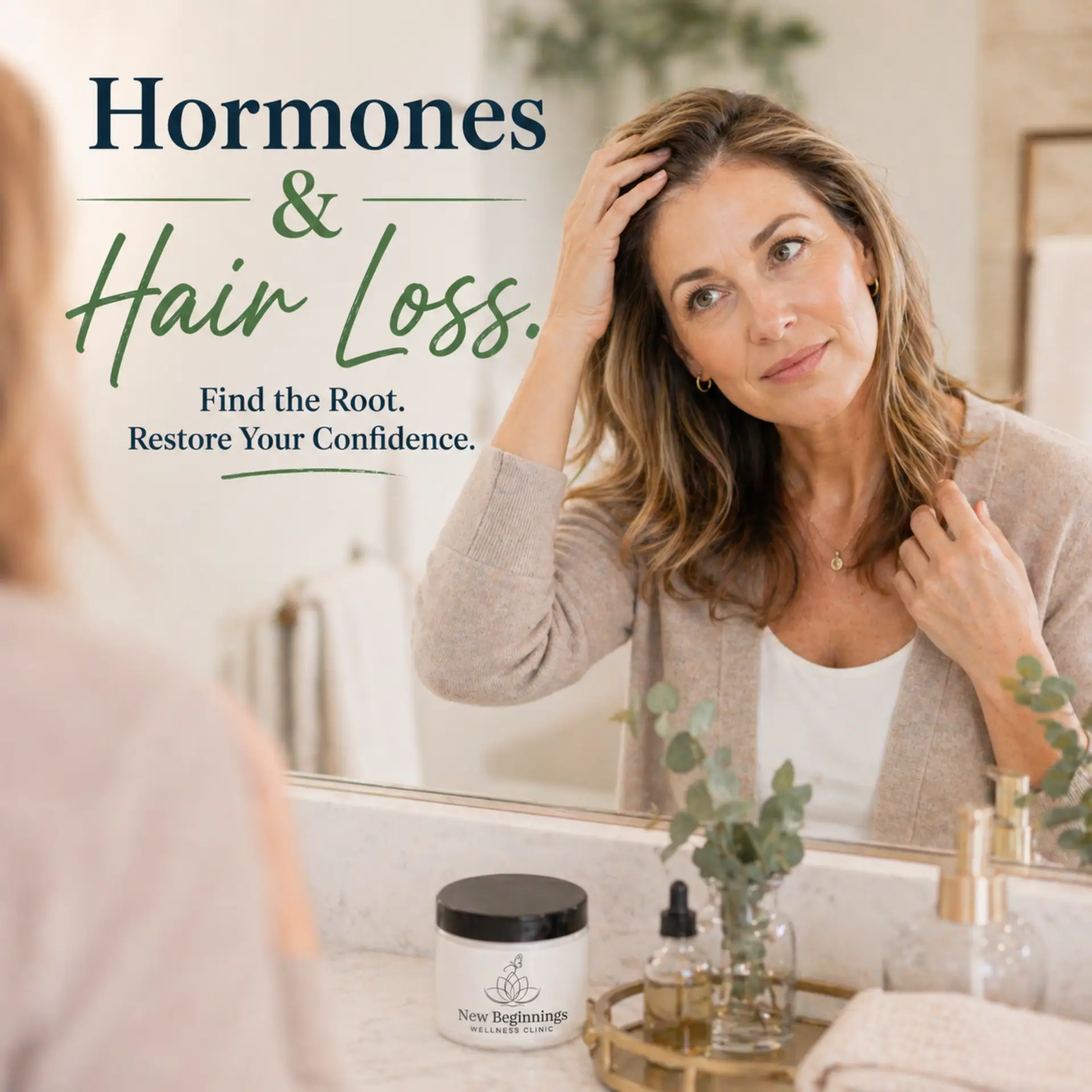
For many women, noticing extra hair in the shower drain or a widening part in the mirror triggers a deep, silent panic that is often dismissed by doctors as a normal part of aging.
But hair loss is rarely just about getting older; it is frequently a loud, visible distress signal from your endocrine system indicating that your hormones are severely out of balance.
At New Beginnings Wellness Clinic, we understand that hair loss is not merely a cosmetic issue—it is an emotional one. Your hair is deeply tied to your sense of identity, femininity, and confidence. When it begins to thin, break, or fall out in clumps, it can feel absolutely devastating.
Unfortunately, when women bring these concerns to a traditional primary care doctor or dermatologist, they are often handed a generic diagnosis of “female pattern baldness,” told it is just a symptom of menopause, or suggested an over-the-counter topical foam. But slapping a topical serum on your scalp or chewing biotin gummies will not fix the problem if the root cause lies deep within your blood.
Your hair follicles are incredibly sensitive to hormonal shifts. To stop the shedding and stimulate regrowth, we have to look closely at the complex interplay between your thyroid, your sex hormones, and your nutritional foundation.
The Thyroid Connection: Your Metabolic Thermostat
Your thyroid is the master controller of your body’s metabolism, dictating how much energy your cells use. Your hair follicles are highly active, metabolically demanding tissues. Because hair is not essential for your biological survival, it is one of the very first things your body neglects when your metabolism slows down.
When your thyroid is underperforming (hypothyroidism), your body essentially goes into energy-conservation mode. It halts the production of non-essential tissues to save energy for your heart, brain, and lungs. This prematurely forces your hair follicles out of their growing phase (anagen) and into their resting and shedding phase (telogen).
The tragedy of the traditional medical system is that many women are told their thyroid is “normal” based solely on a standard TSH (Thyroid Stimulating Hormone) test. At New Beginnings Wellness Clinic, we know that TSH is not enough. We run a comprehensive panel to look at Free T3, Free T4, and Reverse T3 to uncover hidden, subclinical thyroid dysfunction that could be suffocating your hair follicles.
Estrogen and Progesterone: The Hair Protectors
During pregnancy, when estrogen and progesterone levels are sky-high, women often experience the thickest, most luxurious hair of their lives. That is because estrogen is a powerful “pro-growth” hormone that keeps your hair anchored in its growing phase for a much longer period.
As women enter perimenopause and menopause, estrogen and progesterone levels naturally begin to plummet. Without the protective barrier of estrogen, the hair growth cycle shortens drastically. Hair falls out faster than the body can replace it, and the new hair that does grow in is often finer, weaker, and more prone to breakage. Restoring these protective hormones through customized Bioidentical Hormone Replacement Therapy (BHRT) is often the key to halting this menopausal shed.
The Testosterone Factor in Women
While estrogen protects hair, an imbalance in androgens (male sex hormones) can actively destroy it. Yes, women need testosterone for energy, libido, and muscle tone, but it requires a delicate balance.
If a woman has excess androgens—often driven by conditions like Polycystic Ovary Syndrome (PCOS), extreme stress, or insulin resistance—her body can convert that excess testosterone into a potent byproduct called DHT (Dihydrotestosterone).
DHT is notoriously toxic to hair follicles in genetically susceptible individuals. It binds to the receptors in your scalp, causing the hair follicles to shrink (miniaturize) over time. This leads to the classic “androgenic alopecia” pattern, which in women typically presents as a widening of the part and overall thinning at the crown. Balancing testosterone and improving insulin sensitivity stops this destructive conversion in its tracks.
The Hidden Culprit: Ferritin and Nutritional Deficiencies
You cannot out-medicate a nutritional deficiency. Even if your thyroid and sex hormones are perfectly optimized, your hair will not grow if your body lacks the raw materials to build it.
The most commonly overlooked culprit in female hair loss is low ferritin. Ferritin is the protein that stores iron in your tissues. If your ferritin is low, your body cannot produce adequate hemoglobin, meaning less oxygen and fewer nutrients are delivered to your scalp.
Here is where the “normal vs. optimal” trap strikes again. A standard lab might flag your ferritin as “normal” anywhere between 15 and 150 ng/mL. However, clinical studies show that for healthy, robust hair growth, a woman’s ferritin levels typically need to be well above 70 ng/mL. If your level is 16, traditional doctors will say you are fine, but your hair follicles are essentially starving.
Healing from the Inside Out
You do not have to accept thinning hair as your permanent reality. At New Beginnings Wellness Clinic, we treat hair loss the way we treat all chronic symptoms: by investigating the root cause.
When you sit down with Amanda McDole, we review your comprehensive lab panels to identify exactly what your body is missing. Whether you need your thyroid optimized, your estrogen and progesterone replenished via BHRT, your DHT blocked, or targeted medical-grade nutraceuticals to fix a ferritin deficiency, we create a precision protocol designed specifically for you. By balancing the internal environment, we create the perfect foundation for your hair to thrive once again.
Disclaimer: The medical information discussed in this article is intended for general informational and educational purposes only and should not replace personalized medical advice. Every patient is unique, and all treatments are customized to fit individual lab results, symptoms, and comprehensive health profiles.
Are you ready to stop the shedding and get your confidence back? Stop wasting money on topical band-aids and discover the hormonal root of your hair loss. Contact Amanda McDole and the compassionate team at New Beginnings Wellness Clinic today. Call us at (419) 847-3458 or visit us online at nbwclinic.com to schedule your comprehensive lab review and personalized consultation.